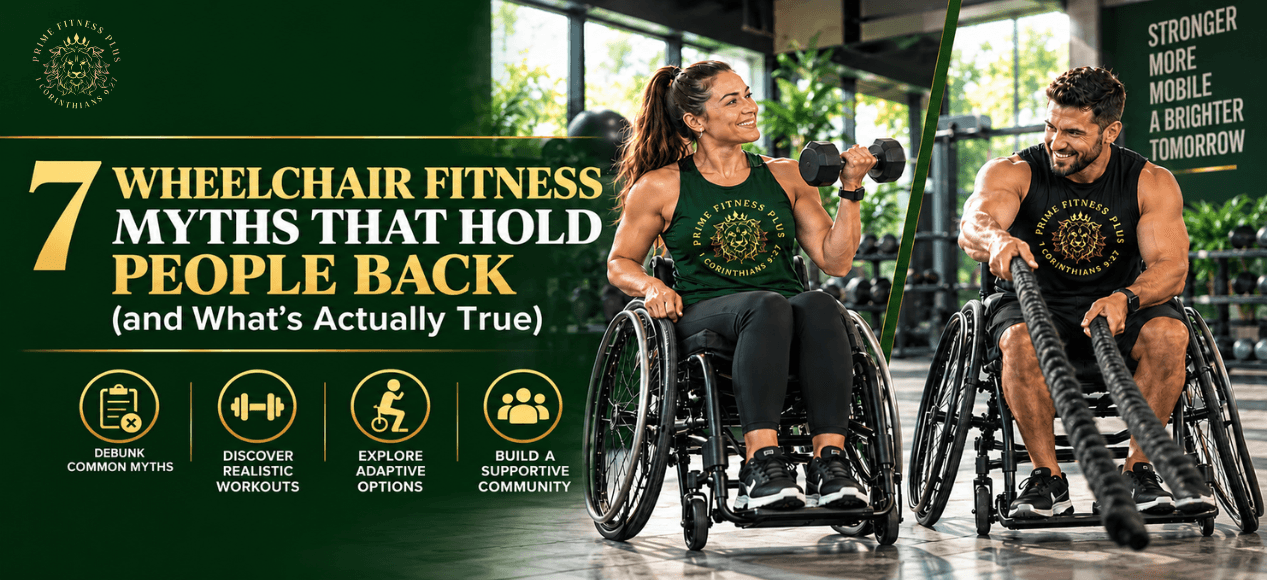
Ask ten people what exercise looks like for a wheelchair user, and you’ll likely hear ten different answers, many of them wrong. Outdated ideas about disability and fitness still circulate in gyms, social media, and even well-meaning advice from family and friends.
These myths do real harm. They convince people to skip exercise, delay getting started, or settle for much less than their bodies can do. This article clears up seven of the most common wheelchair fitness myths and explains what to do instead.
Myth 1: “Wheelchair Users Can’t Get a Real Workout”
The truth: You can train hard, build strength, and improve endurance from a seated position.
A workout is defined by effort and consistency, not by whether you’re standing. Seated strength training, arm cycling, boxing-style movements, and resistance work all challenge the muscles and raise the heart rate. Wheelchair athletes in basketball, racing, rugby, and other sports are proof that seated training can reach a very high level.
Your starting point may look different from someone else’s, but the principle is the same: apply a challenge, recover, and gradually do a little more.
Myth 2: “Exercise Is Only for Rehabilitation”
The truth: Fitness is not just a medical task. It’s part of everyday health.
Some people first encounter exercise through physical therapy, so it can feel like something done only after an injury or illness. But general fitness has its own value.
Regular activity supports heart health, mood, sleep, energy, and long-term independence for almost everyone.
Therapy and fitness can work together. Therapy often focuses on recovery or specific goals, while ongoing fitness helps you build on that progress and maintain it.
Myth 3: “Pushing My Chair Is Enough Exercise”
The truth: Daily wheelchair use is physical, but it isn’t a complete fitness routine.
Pushing a manual chair takes effort, and many people do work their arms and shoulders every day. But it’s repetitive, and it mainly uses the same muscles in the same way. Over time, that can create muscle imbalances and put extra strain on the shoulders.
A well-rounded routine adds variety. That means working the muscles that don’t get used much, such as the upper back and core, while giving overworked areas a chance to recover. It also means including some heart-raising activity and gentle mobility work.
Myth 4: “You Can Only Train Your Arms”
The truth: Your arms matter, but they’re only one part of the picture.
Many people assume that seated fitness equals arm exercises. In reality, a balanced approach looks at several areas:
- Core and trunk, which support posture, balance, and transfers
- Upper back and shoulders, which help protect against pain and overuse
- Chest and arms, which support pushing and daily tasks
- Flexibility, which keeps joints moving comfortably
- Cardio, which supports heart and lung health
Depending on your ability, you may also be able to train your legs through supported or assisted movement. A physical therapist or adaptive trainer can tell you what is realistic and safe in your case.
Myth 5: “It’s Too Risky to Exercise With a Disability”
The truth: Being inactive carries risks too, and a smart plan reduces the danger of exercise.
It’s reasonable to worry about injury, especially if you’ve had an injury before or live with a condition that affects balance, circulation, or sensation. The answer isn’t to avoid exercise. It’s to plan it carefully.
A few sensible steps make a big difference:
- Talk to your doctor or physical therapist before starting a new routine
- Begin with low intensity and short sessions
- Learn the warning signs that mean you should stop, such as sharp pain, dizziness, or chest discomfort
- Use proper support, such as a stable chair, straps, or a trained spotter when needed
Some conditions need extra care. Spinal cord injuries, blood pressure changes, or spasticity are good examples. That’s a reason to get personalized advice, not a reason to stay inactive.
Myth 6: “You Need Expensive Equipment or a Gym Membership”
The truth: You can build a solid routine with very little.
A set of resistance bands and a pair of light dumbbells will cover many needs. Your body weight, a sturdy chair, and a towel can handle even more. Equipment and gym access can be helpful, especially for variety or for adaptive machines, but they aren’t requirements.
If you do want to join a gym, look for one that’s genuinely accessible, with usable equipment and supportive staff. If that’s not available nearby, home workouts, community recreation centers, and online adaptive classes are worthwhile alternatives.
Myth 7: “If I Can’t Do It Perfectly, It Doesn’t Count”
The truth: Modified movement still builds strength.
Many people give up because they can’t copy an exercise exactly as shown in a video or brochure. But exercises are tools, not tests. A smaller range of motion, fewer repetitions, a lighter band, or a supported position still challenges your muscles.
Progress rarely looks like a perfect rep. It looks like doing a bit more than last month, feeling steadier in a transfer, or ending the day less tired. Those changes count.
Why These Myths Persist
Most fitness content is made for people who can stand, walk, and run, so wheelchair users are rarely shown or considered. As a result, assumptions fill the gap. Some come from kind intentions, like “you shouldn’t push yourself.” Others come from outdated ideas about what disabled bodies can do.
You don’t have to accept either. Better information is easier to find than it used to be, from adaptive fitness organizations to trainers who specialize in inclusive training.
How to Start Without Falling for the Myths
If you’re ready to begin, keep it simple:
- Get medical clearance if you have a condition that affects exercise safety.
- Pick one small goal, such as two short sessions a week.
- Start with what feels manageable, and increase gradually.
- Look for qualified guidance, ideally from someone with adaptive fitness experience.
- Track how you feel, not just what you lift. Energy, posture, and confidence are real results.
- Be patient. Consistency matters more than intensity in the early weeks.
Conclusion
The idea that wheelchair users can’t or shouldn’t exercise is outdated. With the right approach, seated training can build strength, improve endurance, protect joints, and support independence. You don’t need perfect equipment, perfect form, or perfect conditions. You need a safe starting point, realistic goals, and the willingness to keep going. The sooner you stop believing the myths, the sooner you can start finding out what your body can do.