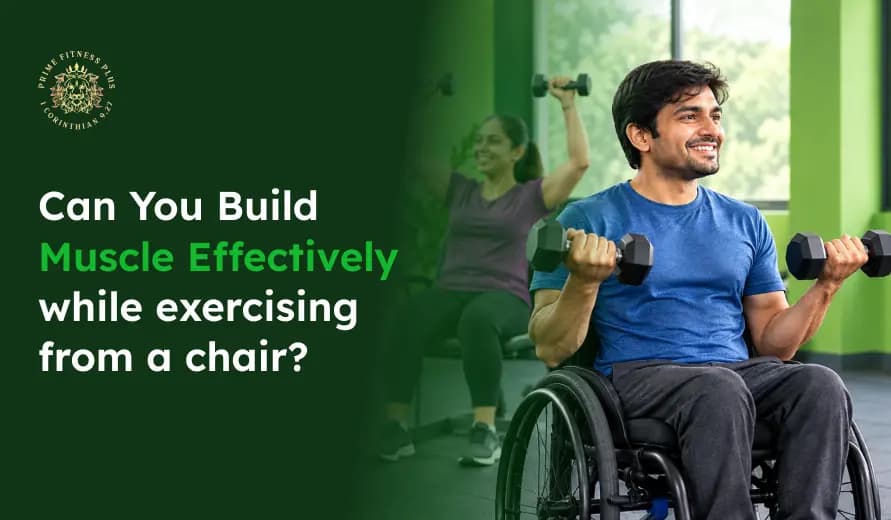
Yes, you can build muscle while exercising from a chair. Seated strength training can help people work their muscles, improve strength, support better movement, and build confidence with regular exercise. A chair can also provide a stable base for people who have difficulty standing, walking, balancing, or doing traditional gym exercises.
Building muscle does not always require standing exercises, heavy weights, or complicated gym equipment. What matters most is providing enough resistance and training regularly. For people with disabilities, mobility limitations, or a preference for seated exercise, chair-based workouts can be a practical part of a fitness routine.
The key is to choose exercises that match your current abilities and gradually increase the challenge as your strength improves.
How Can You Build Muscle From a Chair With Seated Strength Training?
Muscles grow and become stronger when they are challenged with resistance. That resistance can come from dumbbells, resistance bands, cable machines, medicine balls, or even controlled body movements.
When exercising from a chair, you can train several major muscle groups, including:
- Chest
- Shoulders
- Upper back
- Arms
- Core
- Hips
- Thighs
- Lower legs
For example, seated chest presses can work the chest, shoulders, and triceps. Seated rows can target the upper back and arms. Biceps curls can strengthen the front of the arms, while resistance-band exercises can add extra challenge.
The level of resistance should match your ability. Starting with lighter resistance and focusing on controlled movement is often a better approach than trying to lift too much too soon.
Why Is Seated Strength Training Useful?
Seated strength training offers another way to build strength when standing exercises are difficult or unsuitable.
A chair can provide support during a workout and may reduce the balance demands of standing. This can make certain exercises easier to perform while allowing the person to focus on the muscles being trained.
Chair-based exercise may be useful for people who:
- Use a wheelchair
- Have limited lower-body movement
- Have difficulty standing for long periods
- Experience balance challenges
- Are returning to exercise after a period of inactivity
- Have mobility-related disabilities
- Prefer supported exercise
- Want to add more strength work to an accessible fitness routine
Seated workouts are not only about moving the arms. With the right exercises, people can work on their core, legs, hips, posture, and upper body.
For people who use a wheelchair, strength training can also be one part of a broader wheelchair exercise program that includes mobility, cardiovascular activity, and exercises for everyday movement.
What Chair Exercises Can Help Build Muscle?
A well-planned chair workout can include several types of resistance exercises.
1. Seated Biceps Curls
Hold a light dumbbell in each hand with your arms at your sides. Bend your elbows and bring the weights toward your shoulders. Lower them slowly.
This movement mainly works the biceps.
Suggested starting point:
Try 8–12 repetitions for 1–3 sets, depending on your ability.
2. Seated Shoulder Press
Hold light weights at shoulder level. Press the weights upward in a controlled manner, then bring them back down.
This exercise works the shoulders and also engages the triceps.
People with limited shoulder mobility should use a comfortable range rather than forcing the arms overhead.
3. Seated Chest Press
Resistance bands can be used to provide resistance for a seated chest press. Secure the band behind you or use equipment designed for this movement.
Push the hands forward, then slowly return to the starting position.
This can work the chest, shoulders, and triceps.
4. Seated Resistance-Band Row
A resistance band can be used for pulling movements that target the upper back.
Sit upright and hold the band with both hands. Pull the handles or the band toward your body while gently bringing your shoulder blades together. Return slowly.
This exercise can support upper-back strength and posture.
5. Seated Leg Extensions
If your mobility allows it, straighten one knee and extend the lower leg forward. Hold briefly, then return to the starting position.
This movement targets the muscles at the front of the thigh.
The exercise should be adapted to the person's range of motion and physical abilities.
6. Seated Knee Lifts
Lift one knee at a time while seated in a stable position. Depending on your ability, you can use your hands for support or add light resistance.
Seated knee lifts can engage the hip flexors and abdominal muscles while practicing controlled movement.
7. Seated Core Exercises
Core training can be done from a chair using movements such as seated trunk rotations, controlled reaches, and supported abdominal exercises.
The goal is not to move quickly. Slow, controlled movements help you focus on maintaining good posture and engaging the intended muscles.
How Much Weight Should You Use?
There is no single weight that fits everyone.
A suitable resistance should feel challenging yet still allow you to maintain control. If you cannot complete the movement with reasonable form, the resistance may be too high.
For beginners, light dumbbells or resistance bands can be a good starting point. Some people may begin without added resistance and focus on movement control.
As strength improves, you can gradually increase resistance, repetitions, sets, or exercise difficulty.
For example:
Beginning:
1–2 sets of 8–10 repetitions
Building strength:
2–3 sets of 8–12 repetitions
More advanced training:
Additional resistance or a harder variation may be appropriate.
These are general examples, not a personalized exercise prescription. A fitness professional can help determine the appropriate starting point based on your movement abilities.
Can Chair Exercises Build Muscle Without Heavy Weights?
Yes. Heavy weights are not the only way to challenge muscles.
Resistance bands, light dumbbells, cable equipment, weighted objects, and controlled movements can all provide resistance. The amount of resistance required depends on the exercise and the person performing it.
For someone new to exercise, even light resistance can feel challenging. Over time, the same resistance may become easier. That is when the workout can be adjusted.
This gradual process is called progressive overload. It means increasing the training challenge over time rather than doing the same workout indefinitely.
Progress can come from:
- Adding a small amount of resistance
- Performing more repetitions
- Adding another set
- Using a stronger resistance band
- Slowing down the movement
- Increasing the range of motion when appropriate
- Choosing a more challenging exercise variation
How Often Should You Do Seated Strength Training?
Many people can include strength training on two or more days each week, depending on their goals, health status, and recovery needs.
Rest matters because muscles need time to recover between challenging workouts.
A simple weekly routine could look like this:
Monday: Seated strength workout
Tuesday: Rest or light movement
Wednesday: Seated strength workout
Thursday: Rest or mobility work
Friday: Seated strength workout
Weekend: Rest, light activity, or another suitable form of movement
This is just an example. Someone with limited endurance may need shorter workouts or more rest days.
Consistency matters more than trying to complete an intense workout daily.
For someone seeking more cardiovascular activity, adaptive cardio exercises can be added on separate days or incorporated into a suitable mixed workout, depending on physical ability.
Can You Add Cardio to a Chair-Based Workout?
Yes. Both muscle training and cardiovascular exercise can have a place in an accessible fitness routine.
A chair cardio workout may include repeated arm movements, seated marching, boxing motions, rhythmic movements, or other activities that raise the heart rate while the person remains seated.
People who use wheelchairs may also include wheelchair cardio exercises as part of their weekly activity. The type, intensity, and duration should depend on the person's fitness level and mobility.
Cardiovascular work can be especially useful for someone who spends much of the day sitting. It gives the person another way to stay active without requiring prolonged standing or walking.
How Can You Make Chair Workouts Safer?
Start by using a sturdy, stable chair on a firm surface. Avoid chairs that roll, slide, or feel unstable unless they are specifically designed for the exercise.
Keep the workout area clear of objects that could interfere with movement.
Before starting resistance training, consider a brief warm-up. Gentle shoulder and arm movements, along with comfortable mobility exercises, can help prepare the body.
During the workout:
- Move slowly and with control.
- Avoid holding your breath.
- Stop if you experience unusual pain, dizziness, chest discomfort, or difficulty breathing.
- Do not force a joint beyond a comfortable range.
- Use resistance that you can control.
- Take breaks when needed.
People with disabilities or medical conditions may benefit from working with a qualified adaptive fitness professional before beginning a new exercise program.
Can Seated Exercise Improve More Than Muscle Strength?
Yes. A regular seated exercise routine can support several areas of physical fitness.
Strength training may help with everyday activities such as reaching, lifting, pushing, pulling, transferring, and maintaining body position. Depending on the exercises selected, a chair workout can also provide opportunities to improve coordination, mobility, posture, and muscular endurance.
For wheelchair users and people with limited mobility, upper-body strength can be especially helpful for certain daily tasks. However, every person's needs are different, so exercises should be selected based on their abilities and goals.
This is where functional fitness for wheelchair users can be useful. Exercises can focus on movements related to daily activities, such as reaching, pushing, pulling, transferring, and maintaining body control.
Exercise can also provide a structured way to stay physically active when traditional gym workouts are hard to access.
What If You Have a Disability or Limited Mobility?
A disability does not automatically mean that strength training is off the table.
Adaptive fitness programs can modify exercises, equipment, positioning, resistance, repetitions, and workout duration to suit different abilities.
For example, one person may be able to perform a full seated shoulder press, while another may need a shorter range of motion. Someone else may benefit from using resistance bands instead of dumbbells.
The goal is to find movements that are appropriate for the individual rather than expecting everyone to do the same workout.
An adaptive personal trainer can also help identify suitable exercises and create a structured routine based on mobility, strength, goals, and available equipment.
An exercise for wheelchair users does not have to look the same for everyone. The right movement can vary based on mobility, strength, balance, equipment, and personal goals.
How Long Does It Take to Build Muscle From a Chair?
Muscle and strength changes do not happen overnight. Progress depends on factors such as training frequency, resistance, nutrition, sleep, age, initial fitness level, and overall health.
Some people may notice that everyday movements feel easier before they notice visible changes in muscle size.
Keeping track of progress can help. You might record:
- Number of repetitions
- Resistance used
- Number of sets
- Exercise duration
- Range of movement
- How difficult each exercise feels
- Changes in everyday activities
Small improvements can show that your training is on the right track.
A Simple Seated Muscle-Building Workout
If you are looking for a basic starting structure, a seated workout could include:
Warm-up: 5 minutes of gentle movement
Seated biceps curls: 2 sets of 8–12 reps
Seated chest press: 2 sets of 8–12 reps
Seated resistance-band rows: 2 sets of 8–12 reps
Seated shoulder raises: 1–2 sets of 8–12 reps
Seated knee lifts: 1–2 sets of 8–12 reps per side, if appropriate
Cool-down: 5 minutes of gentle movement
This routine is a general example rather than a personalized program. The exercises, repetitions, resistance, and range of motion should be adjusted as needed.
Final Words
Building muscle does not require every workout to be done on your feet. Seated strength training can be a practical way to work major muscle groups while providing the support of a chair.
With appropriate resistance, consistent training, gradual progression, and exercises tailored to individual abilities, chair-based workouts can become part of a long-term fitness routine.
For people with disabilities or mobility limitations, an adaptive fitness program can provide additional support by tailoring exercises to individual movement needs. The most useful workout is one you can perform safely, repeat consistently, and adjust as your strength changes.