Core strength often gets reduced to a conversation about abs, but for wheelchair users the core plays a far bigger role. It's the foundation for posture, balance, transfers and the everyday movements that make daily life smoother.
Strengthening this area isn't about aesthetics. It's about function, independence and confidence in your body.
This guide walks through why core strength matters for wheelchair users, how it supports daily independence and a set of seated core exercises for wheelchair users that can be adapted to different ability levels.
Why Core Strength Matters for Wheelchair Users
The core includes the muscles of the abdomen, lower back and sides. The "cylinder" that supports the spine and pelvis.
For wheelchair users, this muscle group does constant invisible work: stabilizing the trunk during every reach, turn and shift in weight.
Without dedicated wheelchair core exercises, these muscles can weaken over time, especially if the legs aren't contributing to trunk stabilization the way they would in a standing position.
That can lead to slouched posture, increased strain on the shoulders and lower back and a higher risk of muscle fatigue during activities.
Building core strength helps offset these effects and creates a stable, supported base for everything else the body does.
How Core Strength Supports Independence
A stronger core translates directly into daily function.
Reaching for an item on a shelf, pushing a wheelchair up an incline, shifting position to relieve pressure or transferring from a chair to a bed or car all rely on trunk control.
A conditioned core provides:
- Better posture: Reducing slouching and the strain that comes with it.
- Improved balance: Making it easier to reach, twist or lean without losing stability.
- Safer transfers: More control when moving between surfaces.
- Reduced shoulder and back strain: Since the trunk shares more of the workload.
- Greater confidence in movement: Less hesitation during everyday tasks.
This is why seated abdominal exercises are worth prioritizing, even in short sessions a few times a week.
7 Seated Core Exercises for Wheelchair Users
These exercises can be done directly in a wheelchair or a similar stable seated surface.
Start slow, focus on control rather than speed and stop if any exercise causes pain, as opposed to normal muscle fatigue.
1. Seated Marches
Sit tall with your back supported.
Lift one knee toward your chest, engaging your abdominals, then lower it with control and switch sides.
This simple movement activates the core muscles and hip flexors without requiring any equipment, making it a great warm-up or starting point for an adaptive core workout.
2. Controlled Torso Rotations
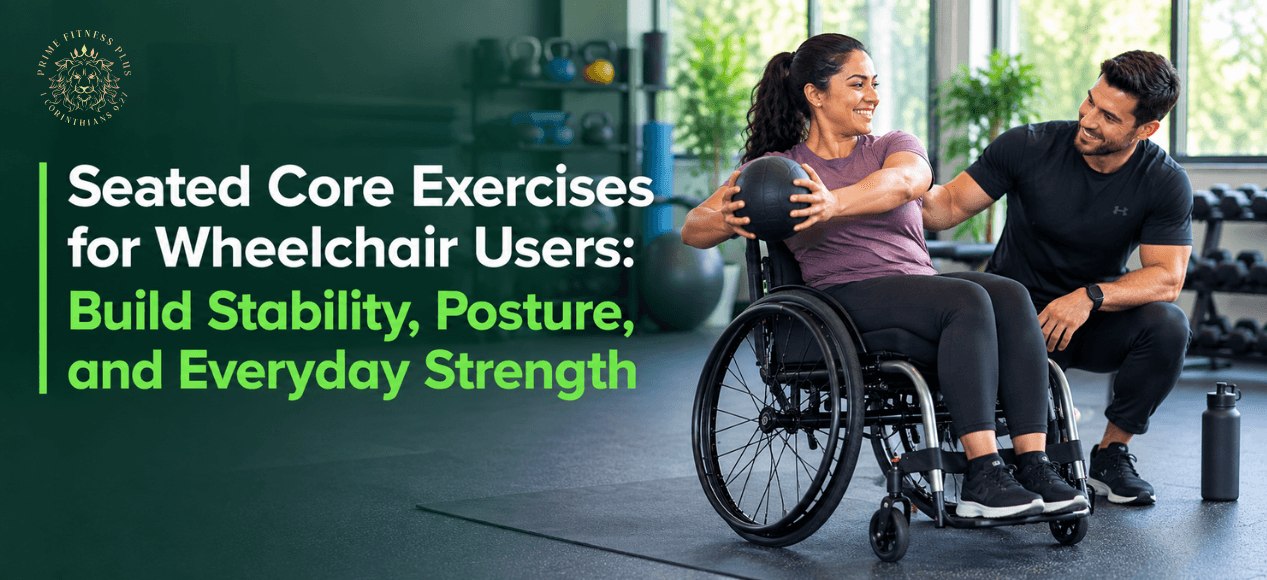
With arms crossed over your chest or hands resting on your shoulders, rotate your upper body slowly to one side, pause, then rotate to the other.
Keep the movement controlled rather than fast.
The goal is engaging the obliques, not momentum.
This is one of the effective seated balance exercises for building rotational control, which is heavily used during transfers and reaching tasks.
3. Seated Side Bends
Sit upright.
Slowly lean your torso to one side, reaching your hand toward the footrest or wheel, then return to center and repeat on the other side.
This targets the muscles along the sides of the torso and helps build the lateral stability needed for leaning and reaching safely.
4. Resistance-Band Rotations
Anchor a resistance band to a point beside you, such as a door anchor or fixed bar, at chest height.
Hold the band with both hands.
Rotate your torso away from the anchor point, then return slowly.
This adds load to the rotational pattern as torso rotations, making it a natural progression once bodyweight versions feel manageable.
5. Seated Knee Lifts
Similar to marches but held longer: lift one knee.
Hold for 2–3 seconds before lowering.
The pause increases time under tension for the abdominals and hip flexors, building more targeted strength than the marching version alone.
6. Forward-and-Back Weight Shifts
Slowly shift your weight forward, hinging slightly at the hips while keeping your back straight.
Then return to a seated position and gently shift backward if your chair and stability allow.
This trains the core to control movement through a range of motion, which mirrors the demands of reaching or repositioning in the chair.
7. Seated Balance Holds
Sit tall without leaning on the backrest, if safe and appropriate for your ability level.
Engage your core and hold the position for 15–30 seconds.
This is a balance exercise that reinforces the postural muscles working continuously to keep the trunk upright.
How to Adapt Core Exercises for Different Abilities
Not every exercise will suit every body. That's expected.
A few ways to adjust:
- Reduce range of motion if a full rotation or bend feels unstable. Smaller controlled movements still build strength.
- Use the backrest for support during balance-focused exercises until trunk control improves.
- Add support with a strap or seatbelt if trunk stability is limited, allowing engagement of the upper body without risking a fall.
- Adjust repetitions or hold times rather than skipping an exercise entirely. Even a few controlled reps offer benefit.
- Substitute isometric holds, like the balance hold, for movements if certain motions aren't accessible.
Adaptive core workout routines aren't one-size-fits-all, and modifying an exercise to fit your body is more valuable than forcing a version that doesn't.
Safety Tips for Seated Core Training
- Check chair stability before starting rotation or reaching movements.
- Engage your core before moving rather than relying on momentum.
- Keep movements slow and controlled with rotations and side bends.
- Use the backrest for extra support when needed.
- Stop if you feel pain, dizziness or unusual strain. Mild muscle fatigue is normal; pain is not.
- Consult a therapist or physician before starting a new routine, especially if you have a spinal cord injury, recent surgery or a condition affecting trunk stability.
This kind of exercise approach is meant to build strength gradually and safely, not push through discomfort.
How Often Should You Train Your Core?
For people, 2–3 sessions per week is a reasonable starting point, with rest days in between to allow muscles to recover.
As strength and confidence build, sessions can increase in frequency or duration.
Consistency matters more than intensity.
A short, regular routine of core strengthening for adults will generally produce better long-term results than occasional longer sessions.
Building a Simple Wheelchair Core Workout
A starting routine might look like this:
- Warm-up: Seated marches — 2 sets of 10 reps per side
- Rotation: Controlled torso rotations — 2 sets of 10 reps per side
- Lateral strength: Seated side bends — 2 sets of 10 reps per side
- Progression (optional): Resistance-band rotations — 2 sets of 10 reps per side
- Hold-based work: Seated balance holds — 2–3 holds of 15–30 seconds
This routine can be completed in 15–20 minutes and adjusted in intensity as strength builds over time.
It touches on flexion, rotation, lateral stability and balance — the core movement patterns relevant to daily function.
Core strength is one of the practical areas to focus on for wheelchair users, directly supporting posture, balance, transfers and overall confidence in movement.
Seated core exercises for wheelchair users don't require equipment or a lot of time. Just consistency and attention to good form.
Starting with movements and progressing gradually allows the core to strengthen safely, supporting a more stable and independent daily routine.