For many wheelchair users, staying active can feel difficult when traditional cardio workouts are designed for standing, walking, running, or jumping. Wheelchair cardio exercises offer another way to get the heart and lungs working while staying seated. With the right movements, people who use wheelchairs can improve cardiovascular fitness, muscle endurance, coordination, and everyday stamina.
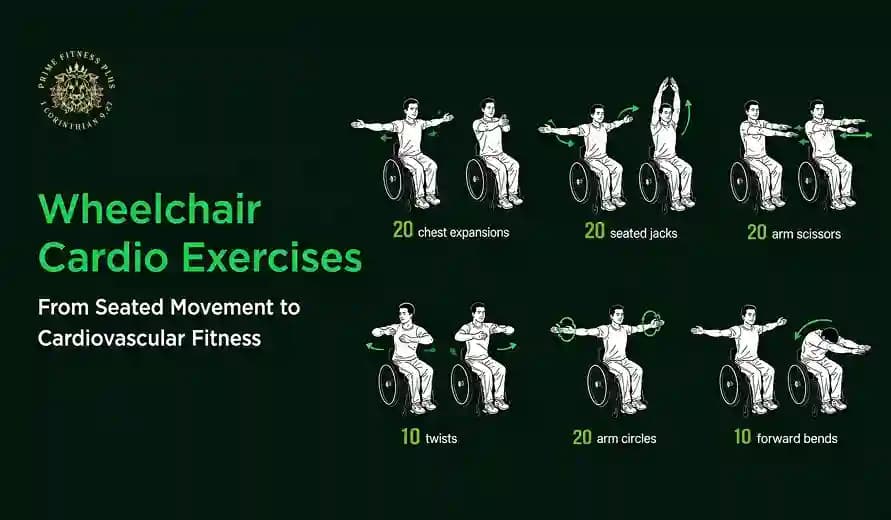
Cardio need not mean running on a treadmill or using a stationary bike. Seated punches, arm reaches, wheelchair pushes, seated marching, resistance exercises, and other rhythmic activities can raise the heart rate while keeping the body supported.
What Are Wheelchair Cardio Exercises?
Wheelchair cardio exercises are rhythmic movements performed while seated to increase heart rate and breathing. They are designed for people who use wheelchairs or have limited lower-body movement and need a seated option for cardiovascular activity.
Cardio can be performed using only bodyweight or with simple equipment such as light hand weights, resistance bands, medicine balls, or an arm ergometer.
Common examples include:
- Seated punches
- Seated arm circles
- Fast arm reaches
- Seated marching
- Wheelchair propulsion
- Seated side-to-side reaches
- Arm cycling
- Seated boxing combinations
- Resistance-band movements performed at a steady pace
- Seated dance movements
The goal is not simply to move the arms quickly. A good wheelchair cardio session uses continuous, controlled movement for a duration that matches the person's fitness level.
Why Cardiovascular Fitness Matters for Wheelchair Users
Cardiovascular fitness supports the heart, lungs, circulation, and the body's ability to handle physical activity. For wheelchair users, regular cardio can also improve stamina for daily activities such as moving around the home, shopping, working, travelling, or participating in community activities.
Regular physical activity may help support:
- Heart and lung health
- Muscular endurance
- Upper-body stamina
- Circulation
- Energy levels
- Balance and trunk control
- Functional mobility
- Mood and mental well-being
- Independence with daily activities
People who spend many hours sitting may also benefit from breaking up long periods of inactivity with short bursts of movement.
7 Wheelchair Cardio Exercises to Try
There are many ways to build a seated cardio routine. The following movements can be modified based on mobility and comfort.
1. Seated Punches
Sit securely in the wheelchair with feet supported and the torso upright. Bring both hands near the chest. Alternate punching one arm forward at a controlled pace.
After becoming comfortable with the movement, gradually increase the tempo.
Try:
- 20 seconds of alternating punches
- 20 seconds of rest
- Repeat 3 to 5 times
Keep the shoulders relaxed and avoid locking the elbows.
2. Seated Arm Circles
Extend the arms to a comfortable position and make small circles with both arms. After several repetitions, reverse the direction of the circles.
Arm circles can be performed slowly during a warm-up or at a faster pace as part of a cardio interval session.
If keeping the arms straight becomes uncomfortable, reduce the circle size or bring the elbows slightly closer to the body.
3. Seated Marching
Seated marching is useful for people who have some lower-body mobility.
Sit upright and lift one knee at a time while moving the opposite arm. Continue alternating sides at a comfortable pace.
If leg movement is limited, the exercise can be modified by focusing mainly on the arms and making smaller leg movements.
Try 30 seconds of movement, followed by 30 seconds of rest.
4. Seated Boxing
Seated boxing can turn simple punches into a more active cardio workout.
Use combinations such as:
- Right punch
- Left punch
- Two quick punches
- Right-left-right-left
- Alternating upper punches
Keep the movements controlled. The goal is continuous movement rather than maximum speed.
A seated boxing session can also include short rest periods to create an interval training session.
5. Wheelchair Propulsion
For people who manually operate a wheelchair, wheelchair propulsion can provide cardiovascular exercise.
Pushing the chair for a continuous period can increase heart rate and breathing, particularly when moving across a safe, level surface.
Start with a short distance at a comfortable pace. As fitness improves, the person may gradually increase the duration or distance.
Outdoor wheelchair propulsion should be performed on suitable surfaces, with attention to traffic, slopes, uneven ground, weather, and personal safety.
6. Seated Side Reaches
Sit tall and reach one arm to the side without forcing the torso into an uncomfortable position. Return to the starting position and repeat on the opposite side.
To move more cardio-focused, alternate sides at a steady pace.
This exercise combines upper-body movement with trunk activity and can be used as a break between higher-intensity exercises.
7. Arm Cycling
An arm ergometer, sometimes called an upper-body cycle, enables a person to pedal with the arms.
The resistance and pace can usually be adjusted. A beginner may start with light resistance and a short duration.
Arm cycling can be useful for structured cardio sessions because the movement is continuous and the workload can be adjusted to suit the person's ability.
How to Build a Wheelchair Cardio Workout
A wheelchair-based cardio workout need not be complicated. A simple session can include three stages: warm-up, cardio activity, and cool-down.
Warm-Up: 5 to 10 Minutes
Begin with gentle movements such as:
- Shoulder rolls
- Slow arm circles
- Easy punches
- Gentle reaches
- Slow seated marching
The purpose is to gradually prepare the body for increased activity.
Cardio: 10 to 20 Minutes
Choose two to four wheelchair cardio exercises.
For example:
30 seconds: Seated punches
30 seconds: Rest
30 seconds: Seated marching
30 seconds: Rest
30 seconds: Seated boxing
30 seconds: Rest
Repeat the sequence several times according to fitness level.
A beginner can use shorter work periods. Someone with more experience may use longer work periods or shorter rest periods.
Cool-Down: 5 Minutes
Finish with slower movements.
Try gentle arm movements, shoulder rolls, relaxed breathing, and comfortable stretches.
The body should gradually return to a resting state rather than stop suddenly after vigorous activity.
How Often Should Wheelchair Users Do Cardio?
The right amount of cardio varies from person to person. Factors such as age, disability, fitness level, medical history, medications, and current activity level all matter.
A practical starting point may be 10 to 15 minutes of moderate activity several times a week. As tolerance improves, sessions can gradually be extended.
Some people may aim for about 150 minutes of moderate-intensity aerobic activity per week, a commonly used adult physical activity target. However, this target is not suitable for everyone, and people with specific medical or mobility needs may require a different plan.
How Do You Know If the Workout Is Moderate?
Heart rate can be useful, but it is not the only measure of exercise intensity.
A simple method is the talk test. During moderate activity, a person should generally be able to speak, though may find it difficult to sing comfortably.
Another option is a perceived-effort scale. A person can rate how hard the activity feels, from very easy to very hard.
Because some disabilities, medications, and medical conditions can affect heart rate responses, perceived effort and professional guidance may be useful when setting exercise intensity.
Safety Tips for Wheelchair Cardio
Safety should come before workout intensity.
Before exercising:
- Check that wheelchair brakes are secure when performing stationary exercises.
- Use appropriate positioning and support.
- Make sure the surrounding area is clear.
- Wear comfortable clothing and suitable footwear when needed.
- Keep water nearby.
- Start with gentle movement.
- Increase activity gradually.
- Stop if unusual pain, dizziness, severe shortness of breath, or other concerning symptoms occur.
People with certain medical conditions should consult a healthcare professional before starting a new exercise program.
Wheelchair users should also consider pressure relief and skin protection, especially during longer sessions. Positioning needs can vary significantly between individuals.
How Adaptive Fitness Programs Can Help
Not every wheelchair user has the same mobility needs. A person with a spinal cord injury may have very different needs from someone with cerebral palsy, multiple sclerosis, limb loss, muscular weakness, or another physical disability.
This is where adaptive fitness programs can be helpful.
An adaptive fitness professional can help modify exercises based on:
- Range of motion
- Upper-body strength
- Trunk control
- Balance
- Wheelchair type
- Fitness level
- Exercise goals
- Personal limitations
- Available equipment
A program may also combine cardio with strength, flexibility, balance, and functional movement training.
For people seeking adaptive fitness training in the United States, working with a provider who understands disability-focused exercise can make it easier to choose movements that match the person's abilities and goals.
Wheelchair Cardio Exercises at Home
You do not need a large gym to start a seated cardio routine.
A small, clear area can be sufficient for exercises such as seated punches, arm circles, side reaches, seated boxing, and marching.
A basic home routine could look like this:
Warm-up: 5 minutes
Seated punches: 1 minute
Arm circles: 1 minute
Seated boxing: 1 minute
Rest: 1 minute
Seated reaches: 1 minute
Seated marching: 1 minute
Rest: 1 minute
Repeat: 1 to 3 rounds
Cool-down: 5 minutes
The routine can be adjusted based on individual ability.
Final Words
Wheelchair cardio exercises offer practical ways to make cardiovascular activity part of an inclusive fitness routine. Seated punches, arm cycling, wheelchair propulsion, seated boxing, marching, and rhythmic arm movements can provide different ways to work the heart and lungs without relying on traditional standing exercises.
The most useful routine is one that fits the person's abilities, goals, equipment, and comfort level. Starting with manageable movements and gradually increasing activity can make regular exercise easier to maintain.
For people who need additional guidance, adaptive fitness professionals can help create exercise programs based on individual mobility and fitness needs. With the right approach, cardiovascular training can become a regular part of an active lifestyle for many wheelchair users.