Every body is different, and so is every path to fitness. Your movement abilities, comfort level, goals, and day-to-day needs all shape how you should train. Still, a lot of workout programs are built around one fixed set of exercises — the same steps, the same pace, the same reps, the same equipment — regardless of who's doing them.
That one-size-fits-all model doesn't work for everyone.
For people managing disabilities, limited mobility, balance issues, joint restrictions, neurological conditions, or simply a different range of physical ability, a workout often needs to bend to fit the person. That's the space adaptive fitness lives in.
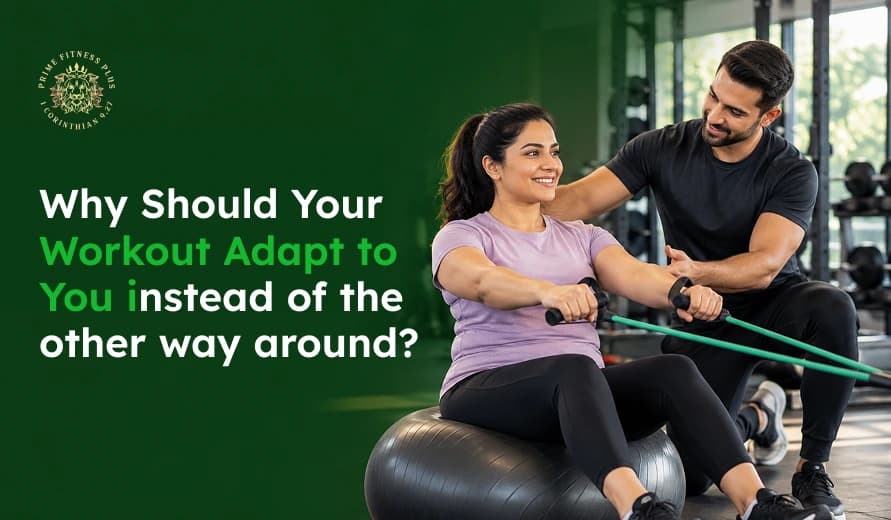
Rather than asking "how do I make my body do this workout?" adaptive training flips the question: "how can this workout be shaped around my body?"
It's a small shift in thinking, but it changes a lot. It can make exercise more comfortable, more realistic, and more useful — helping people build strength, improve movement, hold onto independence, and stay active in a way that actually fits them.
What Does It Mean for a Workout to Adapt to You?
When a workout adapts to you, nearly everything about it can flex: the exercises themselves, the equipment, how many reps you do, how far you move, your pace, your position, and how much support you have along the way.
Take a squat, for instance. One person might do it standing. Another might do a supported sit-to-stand from a chair. Different movements, same muscles working.
The upper body works the same way. Someone comfortable with dumbbells might do a standard shoulder press. Someone with limited hand control might need a different grip, lighter resistance, a resistance band, or an entirely different exercise that reaches the same muscle groups.
That's really the core idea behind adaptive strength training — the exercise bends toward the person, not the other way around.
Why Individual Adaptation Matters
No two people bring the same body, history, or needs into a workout.
Two people can share a goal — say, getting stronger — and still need completely different routes there. One might focus on leg strength. Another might prioritize the upper body because standing or walking is hard for them.
A lot of things can shape how someone moves:
- Balance
- Range of motion
- Muscle strength
- Joint mobility
- Grip ability
- Coordination
- Endurance
- How long they can sit or stand
- Ability to move between positions
- Use of mobility equipment
- Pain or discomfort during certain movements
A standard, off-the-shelf workout rarely accounts for all of that. An adapted one starts somewhere different — with the person. From there, a trainer can figure out what's comfortable, what needs support, and which exercises actually move someone toward their goals.
The Benefits of Adaptive Fitness
Adaptive fitness exercises open up more ways for people to actually get moving. The point was never to make every exercise look identical across every body — it's to find the version of the movement that fits the person in front of you.
1. Exercise Meets You Where You Are
Your current ability is the logical starting line, not some idealized version of what you "should" be able to do.
Someone brand-new to exercise might start with simple, low-resistance movements. Someone who's trained for years might need heavier resistance or a bigger challenge to feel anything at all.
The same logic holds for people with disabilities. A program can start at whatever level someone's at right now and build from there as things change — which is a far more practical approach than dropping someone into a routine built for a completely different body.
2. Movements Can Be Modified
Modifying an exercise isn't a sign that it failed. It's just part of how training works.
A movement can shift in plenty of ways — position, range of motion, resistance, reps, speed, or the equipment used. Someone who struggles with a floor-based exercise might do a similar movement seated instead. Someone who can't reach a full range of motion can work within a smaller range that's still comfortable and effective.
These kinds of adjustments are exactly what make accessible strength training possible, without asking anyone to abandon their goals.
3. Workouts Support Real, Daily Life
Exercise isn't confined to a gym floor.
Strength and mobility show up constantly in everyday life — standing up from a chair, reaching for something on a shelf, carrying groceries, moving from a bed to a wheelchair, or just holding a stable seated position. Because of that, adaptive fitness exercises are often chosen with practical, everyday outcomes in mind.
If someone's working toward standing more independently, a program might build in supported sit-to-stand movements. If reaching is the challenge, upper-body work becomes the focus. Either way, the exercise ties directly back to something that matters in day-to-day life.
What Does Strength Training Look Like for People With Disabilities?
Strength training doesn't require a barbell loaded with plates.
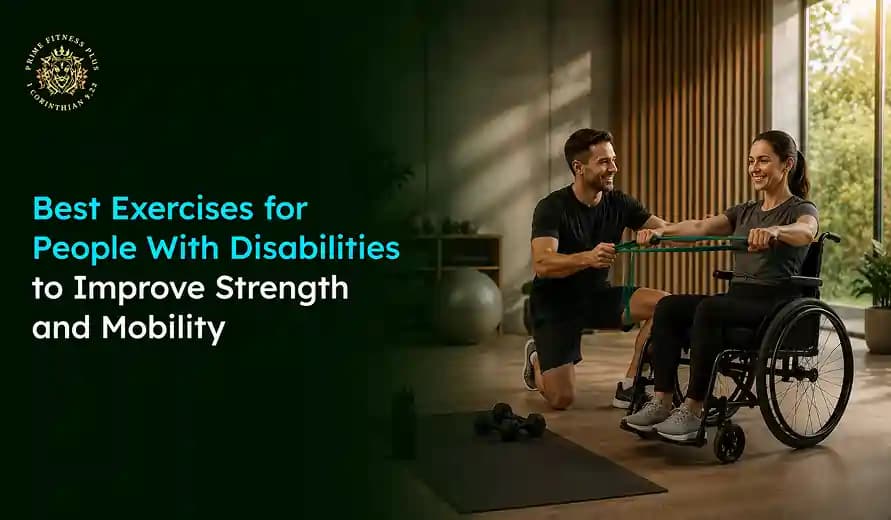
Strength can be built with body weight, resistance bands, machines, light weights, supported movements, or other forms of resistance — whatever fits the person's ability. For someone with limited mobility, that might mean training seated, standing with support, or working from another stable position altogether.
A few examples of strength exercises for people with disabilities:
- Seated leg extensions
- Supported sit-to-stand movements
- Seated chest presses
- Resistance-band rows
- Seated biceps curls
- Supported heel raises
- Grip exercises
- Seated overhead movements
- Light resistance work for the shoulders and arms
Which ones make sense depends entirely on the individual — their abilities, their goals, and what their body needs.
How Can a Workout Be Modified?
There's more than one way to adjust a workout without losing the purpose of the exercise itself.
Change the position. Some exercises can move from standing to seated, or from unsupported to supported.
Reduce the range of motion. Full range isn't a requirement. A smaller, more comfortable range of movement can be a solid starting point.
Change the resistance. Bands, light weights, machines, or body weight all offer different levels of challenge — pick whichever fits.
Adjust the reps. Ten reps isn't some universal rule. Some people start with fewer and build up gradually as it makes sense.
Change the pace. A slower pace can give someone more control over a movement. Someone else might handle a quicker pace just fine.
Add support. A chair, a rail, a stable surface, or another form of support can make a movement far more manageable.
These adjustments aren't exceptions to accessible exercise — they're the normal building blocks of modified workout routines that actually match how someone moves.
Why Accessible Exercise Matters
A workout is nearly impossible to stick with if you physically can't perform it the way it's demonstrated.
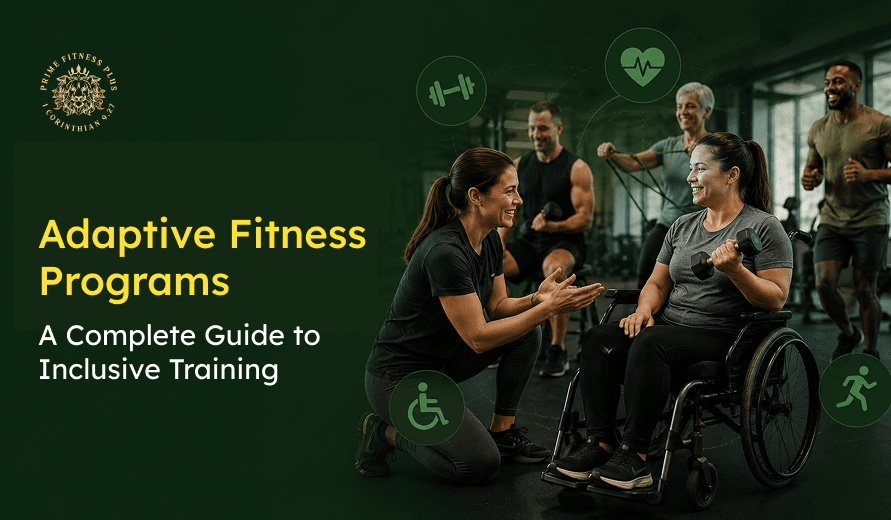
Accessible exercise gives people more than one way in. That matters, because physical activity shouldn't be reserved for people who can already do a traditional gym routine. Someone using a wheelchair, dealing with limited mobility, managing reduced balance, or living with another disability can still take part in structured, meaningful exercise.
The goal is removing barriers that don't need to be there — while keeping the workout appropriate for the person doing it.
Accessible exercise can look like:
- Seated workouts
- Chair-based strength training
- Supported standing movements
- Low-impact exercise
- Resistance-band training
- Mobility-focused movement
- Balance work
- Functional strength training
The right mix depends entirely on the person.
What Are Safe Exercises for People With Disabilities?
There's no single checklist of exercises that's automatically safe for every person with a disability.
Safe exercises for people with disabilities come down to the individual — their abilities, medical background, movement patterns, exercise history, and goals. What works well for one person might not be a good fit for someone else.
That's exactly where professional guidance earns its keep. A qualified fitness professional can help identify movement options that make sense, figure out appropriate resistance levels, and adjust anything that feels uncomfortable or difficult.
It's also worth paying attention to warning signs during exercise — unusual pain, dizziness, trouble breathing, or any sudden shift in how you're feeling. If those show up, stopping and getting proper medical guidance is the right call.
What If You Have Limited Mobility?
Strength training for limited mobility still leaves a lot of room to work with.
A limited range of motion doesn't mean exercise is off the table — it just means the workout focuses on what's available and comfortable. A seated program, for example, can still cover the arms, shoulders, chest, back, legs, and core, with resistance scaled to match ability.
Mobility-focused movements can be layered in too, helping build more controlled movement over time.
The real point is working with the movement someone actually has, rather than judging a workout by how closely it resembles a typical gym session.
Should Your Workout Change Over Time?
Yes — and it probably should.
Strength improves. Mobility shifts. Comfort with a particular movement grows. New goals show up. None of that stays static, so the workout shouldn't either.
Progress shows up in a lot of forms — more resistance, more reps, better control over a movement, needing less support than before, or managing an everyday task with more confidence than you had last month. It doesn't have to be measured only in weight lifted or reps completed.
How Can an Adaptive Personal Trainer Help?
An adaptive personal trainer bridges the gap between exercise and the individual's actual abilities and goals.
Rather than handing someone a fixed routine, the trainer assesses how that person moves and figures out where adjustments would help. That might include:
- Selecting the right exercises
- Adjusting exercise positions
- Choosing appropriate resistance
- Offering movement support
- Changing rep counts
- Modifying equipment
- Building seated or supported options
- Tracking progress
- Evolving exercises as needs change
For anyone who's struggled to find a workout that actually fits their abilities, this kind of approach can make structured exercise feel possible again.
Prime Fitness Plus focuses on adaptive and inclusive fitness, shaping exercise approaches around different abilities and movement needs.
What Should You Look for in an Adaptive Fitness Program?
When you're evaluating a program, ask whether it starts with your needs — or whether it expects you to fit into something already fixed.
Look for a program where:
- Your current abilities are actually considered
- Exercises can be modified
- Your goals are part of the conversation
- Comfort and movement control matter
- Equipment can be adjusted as needed
- Progress gets tracked over time
- Seated or supported options exist when appropriate
- The trainer understands disability-focused fitness
- Communication between you and the trainer is encouraged
A good starting point is simply a conversation — what you can do right now, what you want to work toward, and which movements actually feel okay for you.
Final Words
Exercise was never meant to be a test of whether your body can copy someone else's routine.
Your workout can be shaped around your abilities, your goals, your movement patterns, and where you're at right now. For people with disabilities or limited mobility, that might mean seated exercises, support equipment, resistance bands, modified movements, or shorter sessions.
Modified workout routines offer different ways to build strength, mobility, balance, and everyday function — without forcing everyone into the same routine.
The question worth asking isn't "can I do this exercise exactly as shown?" It's closer to: "how can this exercise change so it works for me?"
That shift alone can make physical activity feel more within reach, and give you a clearer path toward your fitness goals. With the right support and the right adjustments, exercise can become something you actually keep doing — built around what your body can do today, and where you're hoping to go next.