Say "exercise" to most people, and they picture weightlifting, functional mobility exercises hts, a treadmill, sets and reps — the whole gym-routine package. None of that is wrong, exactly, but it's only part of the picture. Just as important is something most workouts never touch directly: how well your body actually handles the movements you rely on all day, every day.
That's the whole idea behind functional mobility exercises — training that stays close to what real life actually asks of your body. Standing up from a chair, walking across a room, reaching for something on a shelf, hauling groceries in from the car, climbing a flight of stairs, getting in and out of a vehicle, just staying balanced while you move — these are the actual tests your body faces, and most of them have nothing to do with how much you can bench.
When a workout is built around these movements instead of around rep counts, it starts to have a clearer point. It's not about doing more reps for the sake of doing more reps. It's about getting the body genuinely ready for whatever the day throws at it.
What "Training for Real-Life Movement" Actually Means
At its core, this is about practising physical actions that map directly onto daily life — often called functional movement training, or just functional fitness.
A session built this way might include things like:
- Squats, which mirror sitting down and standing back up
- Step-ups, for stairs and curbs
- Rows, for pulling and carrying
- Pressing movements, for reaching and placing things
- Core work, for posture and overall control
- Balance drills, for walking and changing direction
- Carrying exercises, for hauling everyday items
- Mobility work, for reaching, bending, and turning
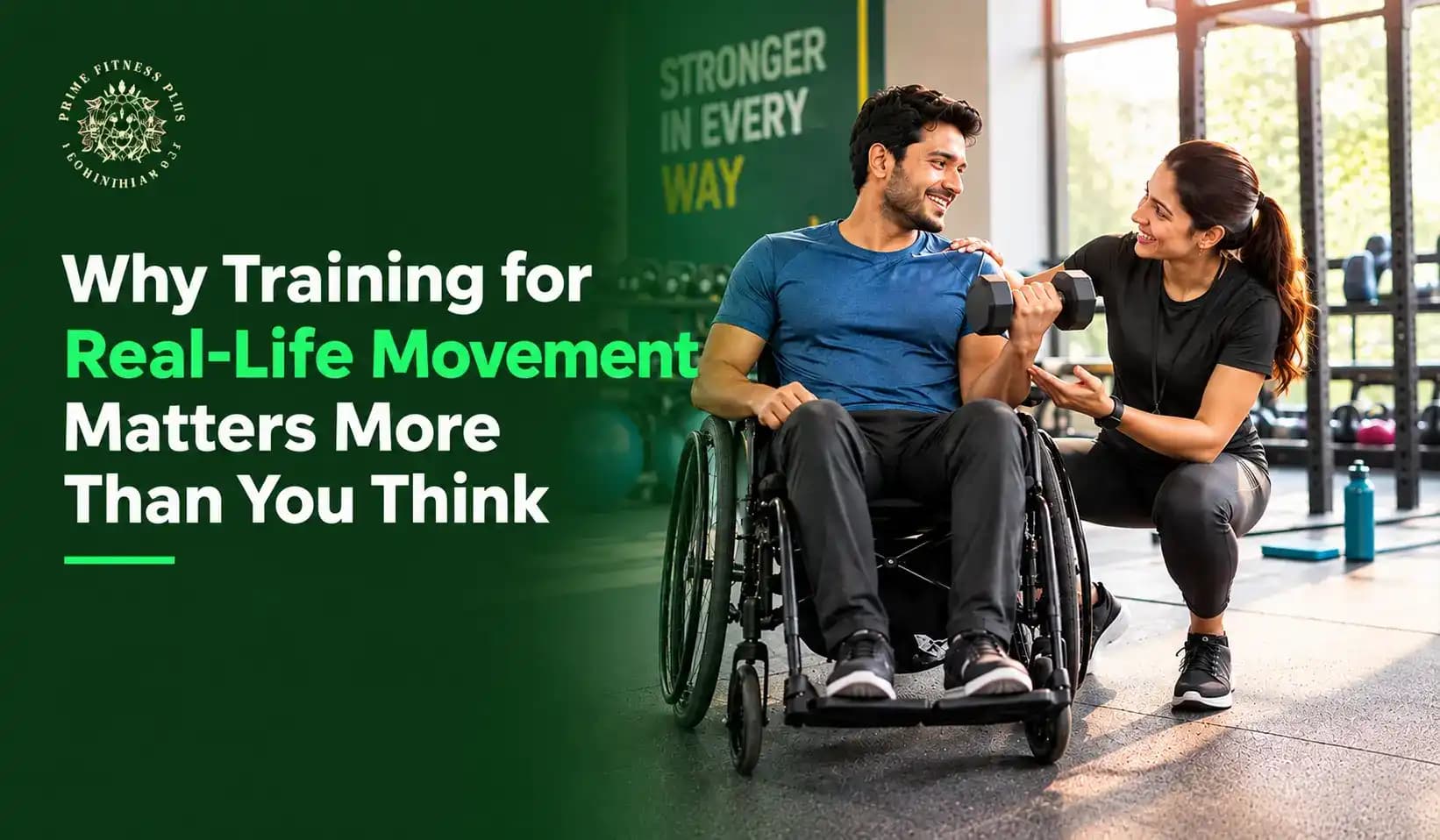
None of this is one-size-fits-all — it gets shaped around a person's strength, mobility, balance, age, experience, and whatever their body actually needs. Someone who uses a wheelchair, for instance, might focus training on upper-body strength, transfers, trunk control, and the reaching and positioning that wheelchair life demands day to day. Someone dealing with limited balance might spend more time on supported standing, slow controlled stepping, and just learning how their body sits in space.
The underlying idea is pretty simple when you strip it down: exercise should connect to how a person actually wants to move through their own life.
Why Gym Strength Doesn't Always Translate to Daily-Life Strength
Being able to move a heavy weight in a controlled setting doesn't automatically mean you can move comfortably through the mess of daily life.
And daily life is messy — nothing about it happens under perfectly controlled conditions. You might need to grab something off the floor mid-turn, carry a bag while walking, reach overhead, push up out of a chair after sitting too long, or dodge around something in your path without missing a step. That kind of movement pulls on several physical abilities at once, not just one.
Among them:
- Strength
- Balance
- Coordination
- Mobility
- Stability
- Body awareness
- Muscular endurance
- Reaction and control
A program that hammers just one of these can leave the others underdeveloped. Someone might have powerful legs and still feel shaky stepping off a curb. Someone else might have real upper-body strength and still struggle to hold posture while reaching for something. That's exactly why a well-built program has to think about how these abilities work together, not in isolation.
Everyday Tasks Get Easier With This Kind of Training
Most people don't think of household chores as "physical tasks" — until they start feeling hard.
Carrying laundry. Standing up from a chair. Moving a box across a room. Walking through a crowded car park. Standing at the counter while cooking. Reaching into a high cabinet. Each of these requires a baseline of strength and control that most people never consciously train for.
This is where functional fitness exercises earn their keep. Repeated sit-to-stand movements build the exact pattern your body uses to get out of a chair. Carry drills prepare you for hauling grocery bags. Step-ups rehearse the motion your legs make when climbing a staircase.
None of this guarantees a task will always be easy — that's not really the promise. What it does is give your body real, repeated practice with movement patterns that show up constantly in ordinary life.
Real-Life Movement Exercises and Daily Function
Real-life movement exercises bring a workout closer to the world outside the gym. Instead of isolating one muscle at a time, a session might string together a squat, a reach, a carry, a step, and a turn — all in sequence, the way your body actually strings movements together outside training.
It also nudges people to think about fitness differently. Instead of "how much can I lift," the more useful question becomes: can I carry my own groceries? Can I get up from a chair without help? Can I walk farther without getting winded? Can I reach that top shelf?
The point was never to recreate every daily task exactly as it happens. It's to train the body in the physical abilities that are actually used in ordinary situations.
How Everyday Movement Training Supports Independence
Independence, in a physical sense, usually comes down to being able to handle ordinary tasks safely and without needing help.
Think about what that looks like in practice — getting dressed unassisted, moving from a chair to standing, cooking a meal, walking through a store, carrying your own things. Each of those calls on a different mix of physical skills.
Everyday movement training gives those specific skills real attention, built around what someone can currently do and what they'd like to be able to do with less assistance from others.
This matters even more for people with disabilities. A standard gym routine often has little to do with the actual movement challenges someone faces at home, at work, at school, or just moving through public spaces. Adaptive fitness programs step in here — adjusting exercises, equipment, positioning, and resistance so training actually fits the person, not the other way around.
Why Functional Mobility Exercises Matter for Daily Movement
Many functional mobility exercises are about restoring or maintaining the movements involved in reaching, bending, turning, walking, standing, and shifting position.
Mobility and strength are partners, not substitutes for one another. It's entirely possible to have plenty of muscle and still struggle with a movement simply because a joint won't move through the range it needs.
Tight shoulders make reaching a high shelf harder. Restricted hips or ankles affect walking, squatting, or climbing stairs. A stiff spine makes turning and reaching feel effortful rather than easy. That's why a movement-focused routine usually includes work on useful ranges of motion alongside the body-control piece.
Balance and Coordination Matter Just as Much as Strength
- Strength gets most of the spotlight in fitness culture, but it's only one piece of functional movement.
- Someone can have plenty of strength to stand yet still wobble while trying to balance. Someone might be able to lift an object just fine but lose their coordination the moment they try to walk while carrying it.
- This is why functional workouts often layer in balance and coordination challenges, gradually and under control. That might look like:
- Supported single-leg movements
- Controlled step-ups
- Reaching while standing
- Direction changes
- Seated coordination drills
- Weight-shifting exercises
- Core stability work
- Walking patterns with controlled stops and turns
The difficulty level always has to match where the person actually is right now — safety comes first, especially for anyone with balance issues or a history of falling.
Mobility Lets You Move Through a Bigger Range
Mobility, in the strict sense, is about moving a joint through a functional range with control — not just flexibility for its own sake. Limited mobility quietly makes ordinary tasks harder than they should be.
Shoulder restriction makes overhead reaching a chore. Tight hips or ankles affect walking, squatting, and stair-climbing. A spine that doesn't rotate well turns something as simple as checking a blind spot into an awkward manoeuvre.
A well-rounded routine often works in:
- Overhead reaching
- Upper-body rotation
- Controlled hip movement
- Bending and straightening the knees
- Ankle mobility work
- Reaching behind the body
This kind of work should stay comfortable and controlled throughout. Pain, swelling, or any sudden change in how something moves is worth flagging to the right health professional — not pushing through.
Functional Training Scales to Different Fitness Levels
One of the best things about this style of training is how easily it scales. Nobody needs to start with heavy weights or complex movement patterns to benefit.
For example, a sit-to-stand exercise can begin on a taller chair. As strength and control build, the seat can be lowered or resistance added. The same principle applies to step-ups, carrying drills, reaching work, and balance exercises — start where you are, and add difficulty as it becomes appropriate.
For people with disabilities, the adjustments might go further still — performing movements seated, with support, using assistive equipment, or through a smaller range of motion. That flexibility is exactly what makes accessible exercise programs genuinely useful for people who don't fit neatly into a traditional gym routine.
Training Should Reflect the Person, Not Just the Exercise
Two people doing the identical exercise might be chasing completely different goals. One wants easier stair climbing. Another wants to stand from a chair without needing a hand. A third just wants enough strength to carry their own groceries without struggling.
Exercise selection should actually track back to what the person is trying to accomplish. A good starting point is asking a few honest questions:
- Which daily movements feel difficult right now?
- What would this person like to do more independently?
- Are there specific movements causing discomfort or hesitation?
- What equipment or support is actually available?
- What can this person safely do today?
Those answers tend to shape a far more meaningful program than picking exercises off a generic list.
The Role of Adaptive Functional Training
For people with disabilities, functional movement often requires a more flexible approach — this is where adaptive functional training comes in.
It focuses on what a person can do while making real room for physical limitations, assistive devices, fatigue, balance concerns, or restricted movement. That might mean seated strength work, supported movements, transfer practice, upper-body conditioning, mobility drills, balance activities, or exercises tied to specific tasks.
The point was never to squeeze everyone into the same workout template. It's to build a movement plan that respects what someone's body can do while still working towards real, practical goals — more confidence moving through home, work, community spaces, or the gym itself.
What Should a Real-Life Movement Workout Actually Include?
A well-rounded session tends to touch a few different categories:
Warm-up — gentle movement to prep the body.
Strength — work for the legs, arms, back, chest, and core.
Mobility — controlled movement through useful ranges.
Balance — body-control challenges in a safe setting.
Coordination — movements that ask the body to manage several actions at once.
Functional practice — exercises tied directly to specific daily tasks.
Cool-down — easy movement and breathing to close things out.
Not every single workout needs every category represented — the right mix depends entirely on the person's goals and physical situation.
How to Actually Start
Getting started doesn't require an elaborate plan. Begin by naming three to five daily activities that genuinely matter to you, then think through what each one physically demands.
- Getting out of a chair: leg strength, hip mobility, balance, body control.
- Carrying groceries: grip strength, upper-body strength, trunk control, walking endurance.
- Using stairs: leg strength, ankle mobility, balance, coordination.
- Reaching overhead: shoulder mobility, upper-body control, trunk stability.
Once those demands are clear, the exercises practically pick themselves. A qualified personal trainer can help assess movement patterns and build something tailored around individual needs, and anyone dealing with specific medical or rehab concerns should loop in the right healthcare professional along the way.
Why This Matters Beyond the Gym
The real difference between ordinary exercise and movement-focused training comes down to one thing: how directly the workout connects to everyday life.
Nobody needs ten textbook-perfect reps of an exercise to get through their day. What they need is the ability to move through constantly changing situations — standing and walking after sitting for a while, picking something up, carrying it to another room, reaching for an item, turning around, stepping over an obstacle, climbing into a car, and maintaining posture through a task.
Functional mobility exercises give all of that a real place inside a workout, instead of leaving it to chance. And that shift — from "completing exercises" to "preparing for real demands" — is what makes training feel connected to actual goals, rather than just a way to change how you look.
Final Words
Fitness earns its value by supporting the life someone actually wants to live — whether training happens in a gym, at home, outdoors, or wherever else makes sense. What matters isn't the setting. It's whether the work genuinely connects to that person's real movement needs.
Functional mobility exercises shift the focus from merely finishing a workout to preparing the body for what everyday life demands — strength, mobility, balance, coordination, and control, all working together towards practical ends. For people with disabilities, adaptive approaches make those same goals reachable in ways a standard program often can't.
The best routine was never the one with the hardest exercises. It's the one that gives someone a real reason to move, fits their actual goals, and holds up under the weight of real life.
When training reflects the movements people genuinely need each day, exercise stops being just a workout. It becomes preparation for living.