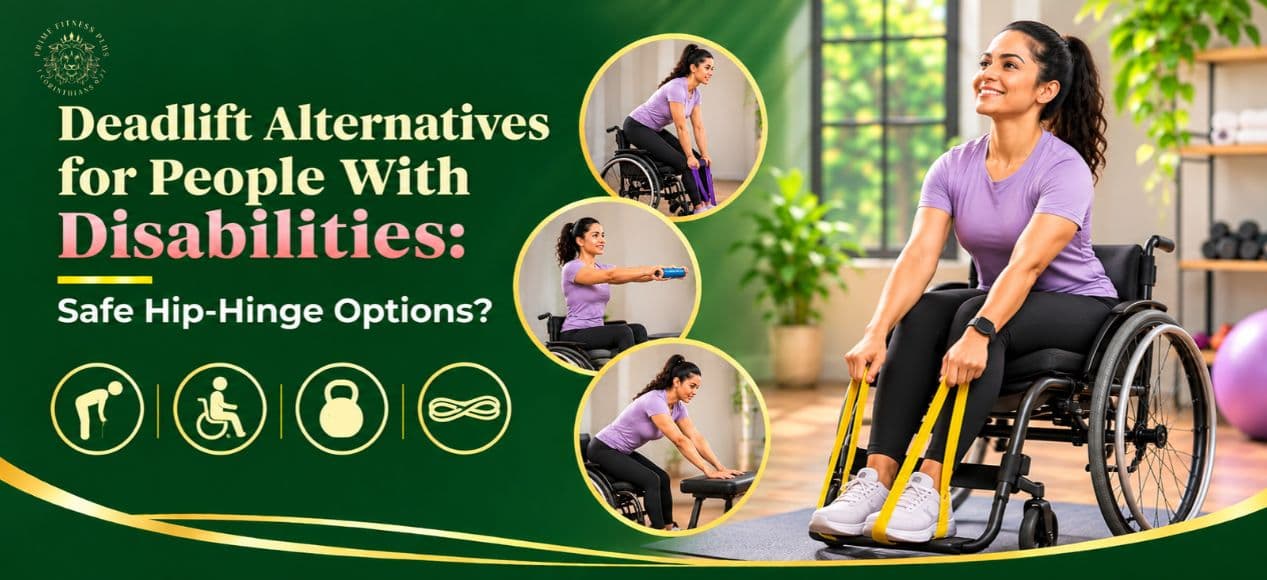
The deadlift trains the hip hinge, the movement of bending forward from the hips with a straight back. It strengthens the glutes, hamstrings and back muscles, which you use every time you pick something up, get out of a chair or lean forward safely.
A full barbell deadlift from the floor needs good balance, hip mobility and back control. Many people with disabilities can train the same pattern with less risk by changing the starting height, the position or the tool.
This guide lists the safest alternatives by ability level. It follows the principles in our guide on how people with different abilities can build strength safely.
Learn the Hip Hinge First
Before adding weight, practise the movement:
- Sit or stand tall.
- Place your hands on your hips.
- Push your hips back and lean your chest forward, keeping your back flat.
- Return upright by squeezing your glutes.
If your back rounds, reduce how far you lean.
1. Glute Bridge (Lying)
Lie on your back with knees bent and feet flat. Press through your heels and lift your hips until your body forms a straight line from shoulders to knees. Hold for 2 seconds and lower slowly.
The bridge trains the same hip muscles as a deadlift with no load on the spine and no balance demand. For people who can transfer to a bed or mat, it is the best starting point.
2. Seated Hip Hinge
Sit near the front of a chair or wheelchair with brakes locked. Hold a light weight or a band anchored under your feet. Lean forward from the hips with a flat back, then pull back to upright. This trains back and hip muscles for people who cannot stand.
3. Raised Kettlebell Deadlift
Place a kettlebell on a step or box so you do not have to bend all the way to the floor. Hinge at the hips, grip the handle and stand up. Lower the box height over time.
4. Sumo Deadlift
Take a wide stance with toes pointed slightly out and hold one dumbbell or kettlebell between your legs. The wide stance keeps your torso more upright, which many people find easier on the lower back than a standard deadlift.
5. Dumbbell Romanian Deadlift
Stand holding dumbbells in front of your thighs. Push your hips back and slide the weights down to about knee level, then stand up. Hold a counter with one hand if balance is a concern, using a single dumbbell.
Start with 2–3 sets of 8–10 reps, twice a week. For a full program around these lifts, see our guide to adaptive strength training.
Safety Tips
- Keep the weight close to your body.
- Keep your back flat. A rounded back under load raises injury risk.
- Breathe out as you stand up.
- Avoid deadlifts if you have an acute back injury, and ask your doctor if you have osteoporosis or spinal fusion.