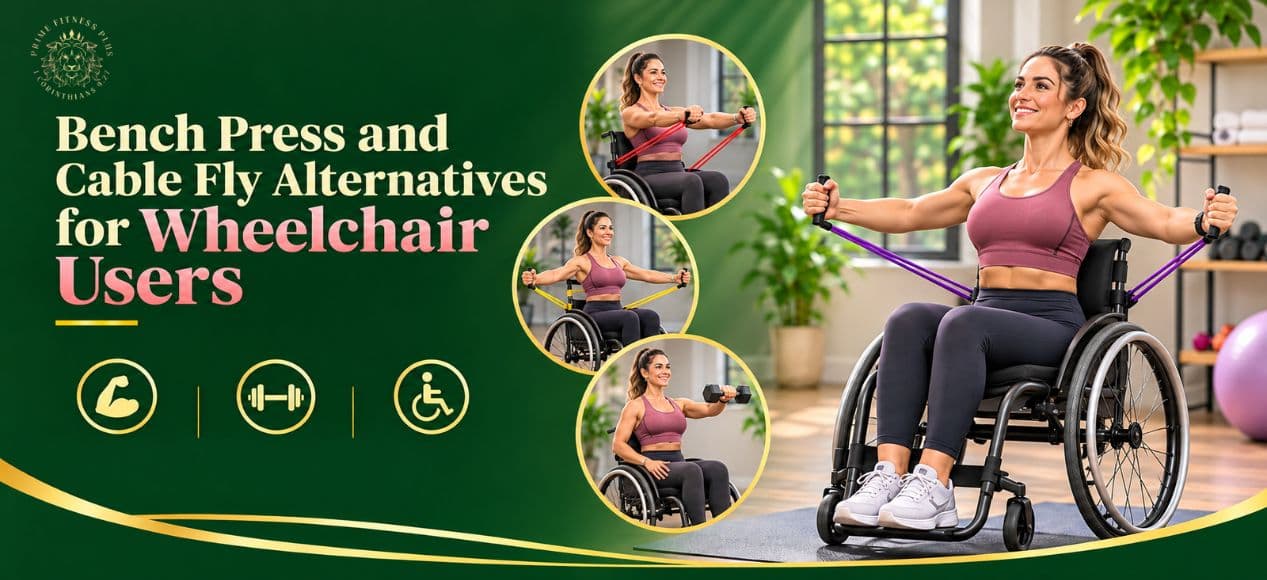
The bench press and the cable fly are the two most common chest exercises in a gym. Both can be adapted for wheelchair users and people with disabilities, either by using seated equipment or by changing the movement slightly.
Chest strength matters for wheelchair users because the chest muscles help with pushing, transfers and reaching forward.
But the shoulders already do a lot of daily work, so chest training needs to be planned with care.
This guide covers safe alternatives you can do from a wheelchair or with minimal transfers. For a full upper-body plan, read our guide to upper body strength exercises for wheelchair users.
Bench Press Alternatives
Seated chest press machine Many chest press machines have a removable or swing-away seat, so you can roll your wheelchair into position. Lock your brakes, set the handles at mid-chest height and press forward without locking your elbows. This is the closest match to a bench press without a transfer.
Resistance band chest press Wrap a band around the back of your wheelchair or a fixed anchor behind you. Hold one end in each hand at chest level and press forward. Bands are light, cheap and easy to use at home.
Dumbbell floor press For people who can transfer to the floor safely, lie on your back and press dumbbells up from your chest. The floor limits how far your elbows go down, which reduces stress on the front of the shoulder.
Dumbbell bench press If you can transfer to a bench, dumbbells allow a more natural arm path than a barbell. Have a spotter help you get the weights into position.
Cable Fly Alternatives
Seated cable fly Position your wheelchair between two cable stations with the handles at chest height. With a slight bend in your elbows, bring your hands together in front of your chest, then return slowly. Keep the weight light.
Resistance band fly Anchor a band behind you, hold the ends with arms open and bring your hands together in a hugging motion.
Seated dumbbell fly (partial range) Hold light dumbbells with arms slightly bent and open them only to the level of your body. Do not let the arms drop far behind you.
Protect Your Shoulders
Shoulder pain is common among manual wheelchair users because pushing and transfers load the same joints every day.
Chest training adds more pushing, so balance it:
- Do at least as many pulling exercises (rows, band pull-aparts) as pushing exercises.
- Keep elbows at about 45 degrees from your body during presses.
- Avoid deep stretches at the bottom of flyes.
- Leave 1–2 reps in reserve instead of training to failure.
Our guide on how to prevent shoulder pain shows the pulling and stretching exercises that pair well with chest work.