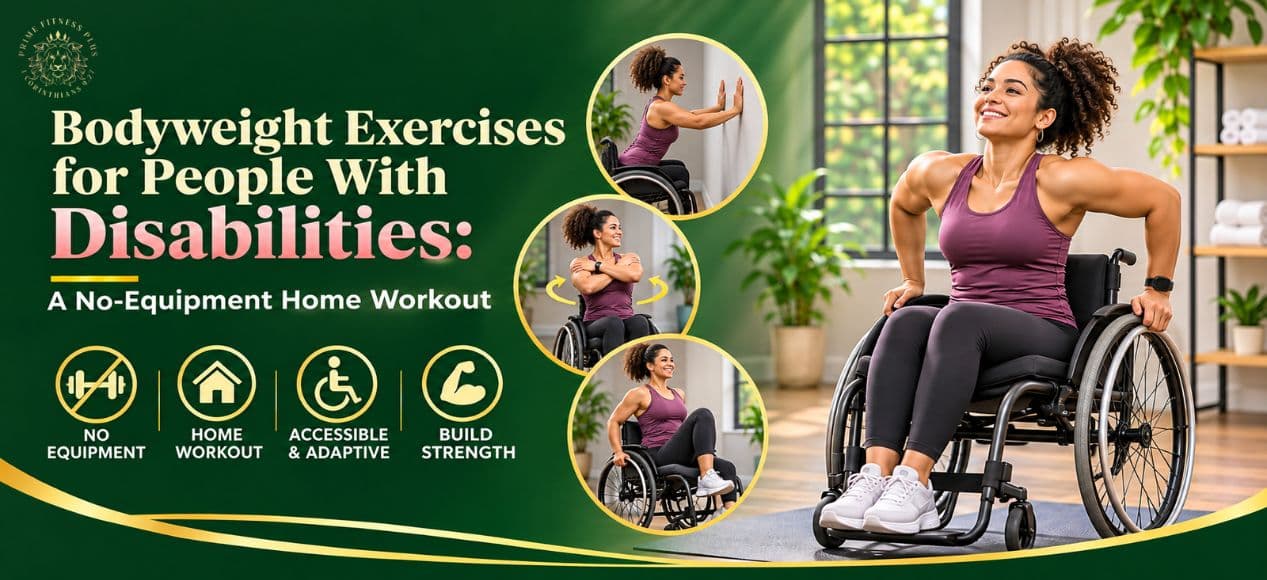
Bodyweight exercises use your own body as resistance. They need no equipment, cost nothing and can be done at home, which removes two common barriers to exercise: travel and gym access.
For people with disabilities, bodyweight training is also easy to adjust. Changing your position, your range of motion or your speed makes an exercise easier or harder without adding any weight.
This workout has a seated version and a supported-standing version. It fits into the structured approach described in our guide to exercise programs for people with disabilities.
What You Need
- A sturdy chair without wheels, or your wheelchair with brakes locked
- A wall or kitchen counter for support
- A mat if you work on the floor
- Water and enough clear space to move your arms
Seated Bodyweight Workout
Do each exercise for 10–12 reps, rest 30–60 seconds, and complete 2–3 rounds.
- Seated wall push-up: sit facing a wall and push your chest away from it.
- Chair dips (partial): place your hands on the armrests and press down to lift your weight slightly off the seat.
- Seated crunch: sit tall, cross your arms and curl your chest toward your knees, then sit back up slowly.
- Seated trunk twist: rotate your upper body side to side with control.
- Superman squeeze: sit tall, reach your arms back and squeeze your shoulder blades for 3 seconds.
- Seated leg lifts: straighten one knee and hold for 2 seconds, if you have leg movement.
Supported-Standing Bodyweight Workout
Use a counter or a chair back for balance. Do 10–12 reps per exercise for 2–3 rounds.
- Sit-to-stand: stand up from a chair and sit back down slowly.
- Counter push-up: push away from a kitchen counter.
- Standing calf raise: rise onto your toes, then lower slowly.
- Side leg raise: lift one leg out to the side while holding the counter.
- Standing march: lift your knees one at a time for 30 seconds.
- Wall sit (short hold): lean your back on a wall with knees slightly bent for 10–20 seconds.
What About Calisthenics?
Calisthenics is advanced bodyweight training, such as pull-ups, dips and handstands. Some adaptive athletes train calisthenics at a high level. Start with the basic exercises above, build strength for 8–12 weeks, then add harder variations one at a time.
Weekly Plan
- 3 days a week: the full workout, with a rest day between sessions.
- Other days: light walking, wheeling or a short stretching session.
For more routine ideas, see our guide to workouts for physically disabled adults.
Safety Tips
- Check that chairs are stable and will not slide or tip.
- Keep a phone nearby when you exercise alone.
- Stop if you feel sharp pain, dizziness or chest discomfort.
- Ask your doctor before starting if you have a heart condition, recent surgery or a new diagnosis.