Mobility is your ability to move a joint actively through its range of motion. It is different from flexibility. Flexibility is how far a muscle can be stretched; mobility is how much of that range you can control with your own strength.
For people with limited mobility, small daily drills keep joints moving, reduce stiffness and make tasks like reaching, turning and dressing easier. You do not need equipment or a gym. Ten minutes a day is enough to make a difference over a few weeks.
This routine fits within a broader plan of adaptive physical activity and can be done seated, in a wheelchair or standing with support.
Before You Start
- Sit tall in a stable chair or a wheelchair with the brakes locked.
- Move slowly and stay in a pain-free range.
- Breathe normally. Do not hold your breath.
- Skip any drill that causes sharp pain and tell your therapist.
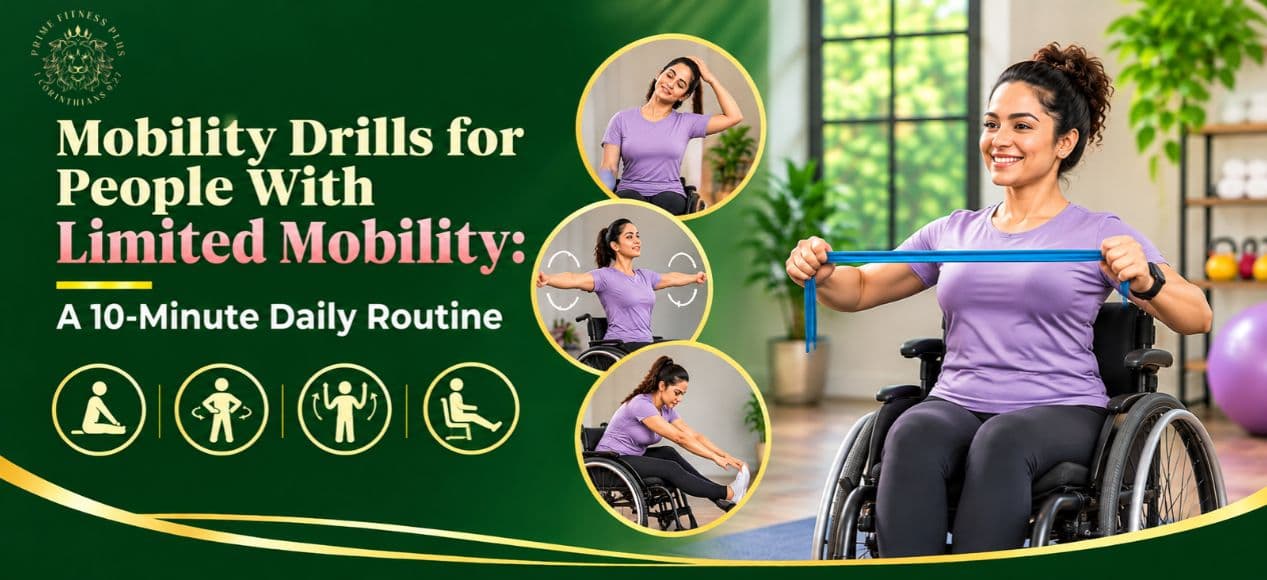
How to Do the Key Drills
Neck turns and tilts Turn your head slowly to look over one shoulder, then the other. Then tilt your ear toward each shoulder. Keep your shoulders relaxed.
Shoulder blade squeezes Pull your shoulder blades back and together as if holding a pencil between them. Hold for 2 seconds and release. This helps posture and balances forward-rounded shoulders.
Seated trunk rotation Cross your arms over your chest and turn your upper body to one side, then the other. Keep your hips still. Hold the armrest if your balance is limited.
Seated side bends Slide one hand down toward the floor while the other reaches over your head. Return to center and switch sides.
Hip hinge With a straight back, lean forward from the hips, then return upright. This keeps the hips mobile for transfers and reaching.
Ankle circles or seated marching If you have leg movement, circle each ankle or lift each knee in turn. If not, a carer can move the ankles gently for you, as advised by your therapist.
Tips for Limited Mobility
- Make the range smaller on bad days. Some movement is better than none.
- Do the routine at the same time each day, for example after breakfast.
- Use a mirror to check your posture.
- Add a light resistance band to shoulder blade squeezes after 2–3 weeks.
Mobility drills prepare your body for the tasks you do every day. Our guide on why training for real-life movement matters explains how to connect these drills to daily goals.