For wheelchair users, the shoulders do the work that legs do for other people: pushing, transferring, reaching and lifting body weight. This constant load is why shoulder pain is so common among manual wheelchair users.
The right shoulder exercises build strength and stability that protect the joint. The wrong ones, or the right ones done with too much weight, can make problems worse. The goal is balanced strength around the whole shoulder, not just bigger front muscles.
This guide covers lateral raises, overhead press options and the small stabilizing exercises that support them. It builds on our guide to exercises for wheelchair users to prevent shoulder pain.
Know the Shoulder Muscles
- Deltoids: the outer shoulder muscle, with front, side and rear parts.
- Rotator cuff: four small muscles that hold the ball of the shoulder in its socket.
- Shoulder blade muscles: the trapezius and rhomboids, which control posture.
Wheelchair pushing mostly uses the front of the shoulder. A good program puts more focus on the side, rear and rotator cuff.
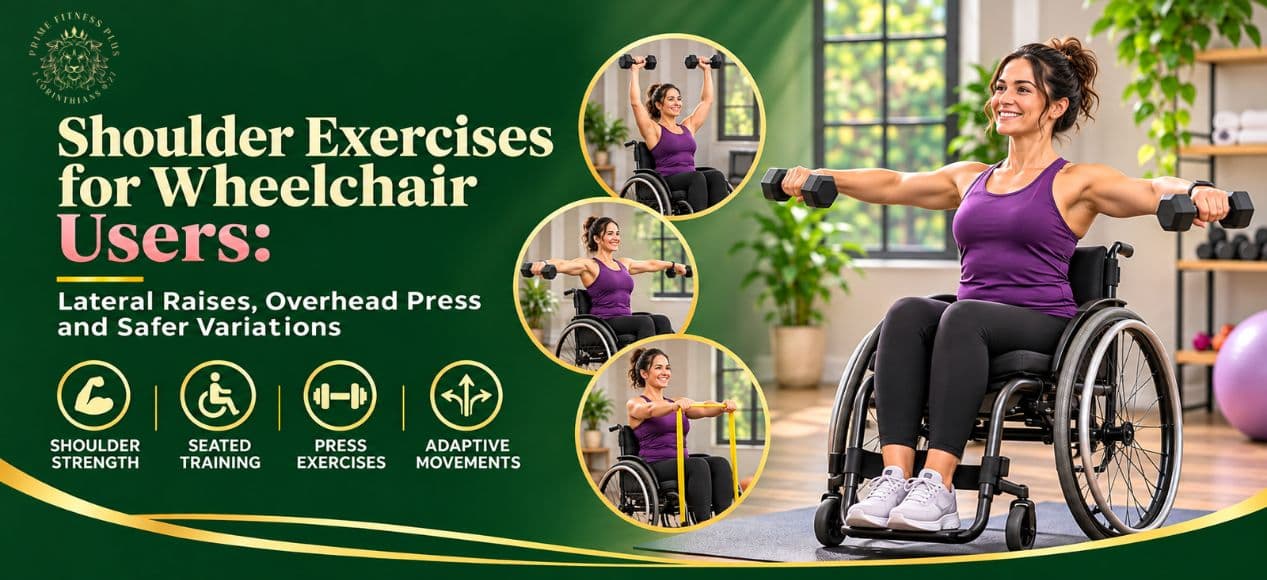
1. Seated Lateral Raise
Sit tall with light dumbbells at your sides. With a slight bend in your elbows, raise your arms out to the sides until they reach shoulder height. Lower slowly over 2–3 seconds.
- Stop at shoulder height. Going higher adds little and can pinch the joint.
- Angle your arms slightly forward, about 30 degrees, which is usually more comfortable.
- Start with 1–2 kg (2–5 lb). Lateral raises need far less weight than presses.
2. Band External Rotation
Hold a band with your elbow bent at 90 degrees and tucked against your side. Rotate your forearm outward, away from your body, then return. This trains the rotator cuff and is one of the most useful exercises for wheelchair users.
3. Rear Delt Fly
Lean slightly forward in your chair and raise light dumbbells out to the sides, squeezing your shoulder blades. This balances the forward pull of pushing.
4. Overhead Press Options
Overhead pressing can be useful, but it is not right for everyone. Only include it if you can raise your arms overhead without pain.
- Neutral-grip dumbbell press: palms facing each other, which is easier on the shoulder than a wide grip.
- Landmine press: press one end of a bar up and forward at an angle, not straight overhead.
- Seated machine shoulder press: guided path and easy to adjust.
If overhead work causes pain, skip it. You can build strong shoulders without it.
Do this twice a week. Pair it with chest and back work from our guide to upper body strength exercises for wheelchair users.
Safety Tips
- Choose a weight you can lift for 12 reps with good form.
- Do not shrug your shoulders toward your ears during raises.
- Avoid behind-the-neck presses.
- Stop if you feel pain at the front or top of the shoulder, and see a physical therapist if pain lasts more than a few days.